Is Open Fan the future of aircraft propulsion?
Published on 1st April 2026
Why a complete rethink on jet engine design could deliver significant efficiency gains and reshape commercial aviation operations
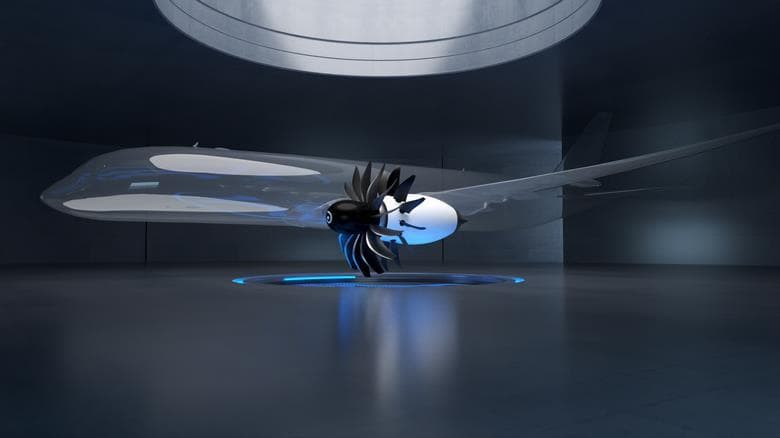
Picture a jet engine stripped of its outer casing, with massive fan blades spinning freely in the open air like an oversized propeller mounted ahead of the wings. The exposed blades, sweeping through graceful arcs, represent a fundamental reimagining of how jet engines could work.
They also just might represent the future of jet engines, potentially making air travel much more efficient, influencing aircraft designs and opening possibilities for innovation in airframes that have changed little since the earliest days of jet travel.
“The Open Fan architecture unlocks a bypass ratio that you can never get to in a ducted configuration, and it adds so much performance benefit to the aircraft,” says Arjan Hegeman, Vice President for the Future of Flight at GE Aerospace, referring to the amount of air bypassing the combustion chamber for more fuel-efficient thrust. “We definitely see that as the future propulsion system.” Billions of euros invested into a multinational effort could make it possible by the mid-2030s.
Rethinking jet travel
The concept of Open Fan engines represents both a return to past ideas and a leap forward. Similar designs emerged in the 1970s and 1980s as unducted fans or propfans, with prototypes achieving fuel efficiency gains of 30 per cent over conventional turbofans of that era. But when fuel prices dropped following changes in oil markets, the economic imperative disappeared, and the programs were shelved. The technology remained dormant for decades.
“Advanced materials and sophisticated computational fluid dynamics have made the Open Fan approach economically viable.”
Now, advanced materials, sophisticated computational fluid dynamics and pressing sustainability concerns have made the Open Fan approach economically viable again. Modern carbon composites can withstand the stresses that limited earlier designs. Supercomputers can model airflow with unprecedented precision. For example, GE Aerospace runs simulations on Frontier, one of the world’s fastest supercomputers, at Oak Ridge National Laboratory in Tennessee, performing more than a quintillion calculations a second to optimize blade shapes for performance and acoustic signature.
CFM International, a 50/50 joint venture between GE Aerospace and Safran Aircraft Engines, leads this effort through its RISE (Revolutionary Innovation for Sustainable Engines) program. The initiative forms a key component of the Clean Aviation Joint Undertaking, a €4.1bn public-private partnership between the European Commission and aviation industry partners that is focused on more efficient aircraft technologies. Clean Aviation aims to achieve at least a 30 per cent reduction in greenhouse gas emissions in advanced aircraft by 2035, with a target to replace 75 per cent of aircraft fleets by 2050. Current research and development efforts focus on solving a unique set of engineering challenges.
Testing new designs
To finally make Open Fan jets a commercial reality, engineers are working to address concerns about exposed rotating blades, manage acoustic signatures and more. For example, Safran says it has conducted nearly 200 mechanical tests on fan blades, including ingestion and vibratory endurance evaluations. The RISE program has recorded 300 hours and counting of wind tunnel testing. Trials have included full-scale static and dynamic fan blade tests, high-speed turbine testing and more than 450 hours of testing on electrical hybridization systems – another innovation being advanced by Clean Aviation that could lead to not only more efficient but quieter flights in conjunction with Open Fan designs.
All the work will come together in the late 2020s, when a full-scale, fully functioning Open Fan engine will take off on an Airbus A380 flight test demonstrator operating from Toulouse. Top of the list of priorities for design and testing is safety, says Pierre Cottenceau, Executive Vice President of Engineering, Research and Technology at Safran.
“Designing for maximum safety will mean putting extra strength in the fan blade and working with the airplane manufacturer to protect the fuselage from any conceivable blade failures,” says Cottenceau. He says a product already in service, CFM’s LEAP engine, has laid the groundwork for the Open Fan design. “We actually have worked for several years now developing the blade for the Open Fan using the experience of the LEAP fan blade.” Safran has run hundreds of tests on new blade designs. “We submit the blade to ingestion and vibratory testing to make sure that it’ll sustain whatever happens in service,” adds Cottenceau. Getting all these pieces right could lead to significant benefits to aviation.
Operational gains
The fundamental physics driving Open Fan efficiency centers on the bypass ratio, the proportion of air flowing around the engine core versus through it. Conventional ducted engines face a constraint: as the fan grows to increase the bypass ratio, the surrounding duct grows proportionally, creating drag that eventually negates the efficiency gains. Ducted engines plateau around a bypass ratio of 15 to 1. “With an Open Fan, where you remove the duct and you don’t have that drag, you can make the fan as large as you want to,” says Hegeman. “You’re solely limited by how much space you have on the aircraft.” Current studies explore Open Fan engines with bypass ratios exceeding 60 to 1 – a massive efficiency increase.
The advantages extend further. “The Open Fan makes the engine extremely durable,” says Hegeman. Unlike conventional engines that derive efficiency from the high-temperature high-pressure engine core, Open Fans achieve their primary efficiency gains through the cold, low-pressure fan section, which puts less stress on components. “It is much, much more durable, much more maintainable at a much lower cost,” Hegeman adds. Increased durability should translate into reduced maintenance requirements and lower operating costs for airlines. When combined with fuel savings that could offset up to 40 per cent of an airline’s operating expenses, the economic case becomes compelling.
“The Open Fan represents a radical change and offers many new opportunities from a technology perspective.”
“The Open Fan represents a radical change in engine architecture and, therefore, offers many new opportunities from a technology perspective,” says Frank Haselbach, Head of Propulsion Engineering at aircraft-maker Airbus. “Integrating this engine architecture into an aircraft presents a significant challenge, and various configuration options are currently under investigation.” For example, with fans mounted ahead of rather than below wings, airflow over wing surfaces can be optimized to generate more lift, further increasing fuel efficiency. Such adjustments will require close coordination between engine and airplane manufacturers.
“Any next-generation propulsion system will have a lot more interaction and interfaces with the aircraft that need to be optimized,” says Hegeman. The close coupling between engine and airframe could benefit passengers. For example, rethinking airframes to accommodate larger-diameter engines could lead to aircraft configurations with roomier cabins. Hegeman says when Open Fan jets take to the skies, we may notice some changes. “The aircraft will start to look a little different. The engines will look different. The experience of flight will be quieter and much, much more fuel efficient, with fewer emissions.”
# # #
This content was produced in partnership with the Financial Times Commercial department.
Share this article